

When Humanoids Hit the Catwalk
Hello, my Power Souls,
This is my second blog. It isn’t always easy to bridge the gap between AI and what I do in fashion. But inspiration rarely comes from just one direction.
Fashion is never just fabric. It is power. It is status. It is narrative stitched into skin, but something is shifting. Not subtly. Not slowly. Fundamentally. And this time, it’s not just digital filters or AI campaigns. It’s embodiment. This evolution comes from many places in my life. From my studies at WBS, guided by a professor who lives and breathes technology.
From my daughter, Samira, a child with special needs who opened my eyes to robotics, digital systems, and alternative forms of communication.
What started as a necessity understanding, learning, diving deep became inspiration. Robotics. AI. Graphic design. Video editing. Even writing music in quiet moments, translating emotion into sound. And now… at this stage in my life, I’ve been given the opportunity to work as a model. It’s beautiful. But it is also confronting.
Can AI replace me? Or more provocatively: can a humanoid model replace us all?
The Robot Has Entered the Atelier
We’ve already seen the prototype phase. Balenciaga experimented with virtual models and digital runways. Prada collaborated with AI artists. Louis Vuitton integrated gaming environments into fashion storytelling. Dior explored immersive digital scenography.
But that was simulation. Now we move toward physical AI bodies.
Designers Who Already Played With the Machine
This isn’t new. The fashion avant-garde has flirted with robotics for decades. Hussein Chalayan created transforming robotic dresses in 2007 garments moving mechanically on the body. Iris van Herpen collaborated with engineers to merge 3D printing, kinetic structures, and algorithmic design. Alexander McQueen used holograms and animatronics to question what human presence means on a runway. They weren’t replacing models. They were testing the boundary between organism and mechanism.
The Humanoid on the Runway
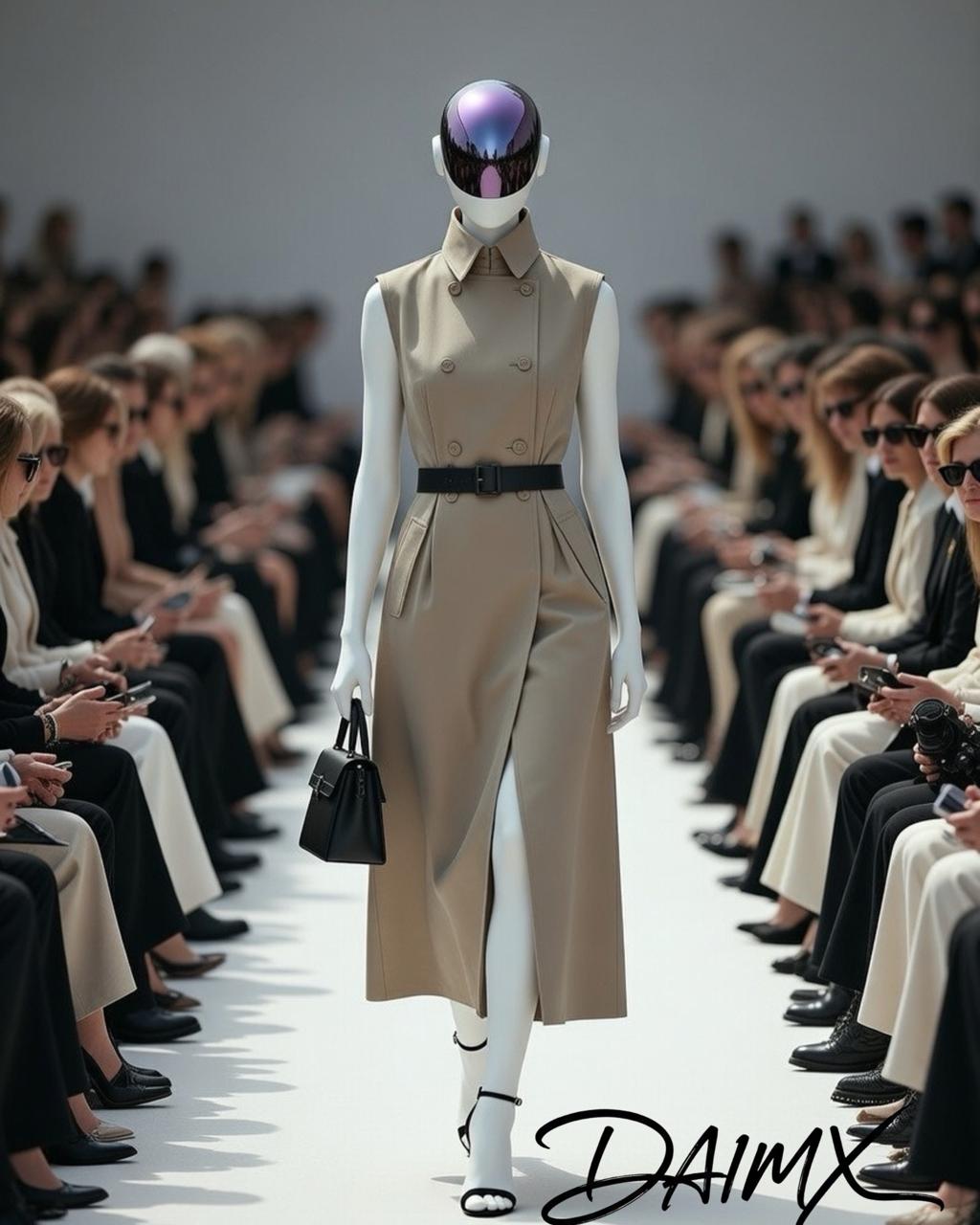
Imagine this: A model walks the catwalk. Serenity. Perfect synchronization. Human proportions. No trembling knees; no insecurity. But it’s not a human. It’s XPeng Iron, developed by XPeng Robotics.
A humanoid robot engineered with human stature and fluid movement. Mechanical precision that blurs the line between man and machine, no nerves; no doubt; no past, only execution.
And that forces the question: What does this mean for fashion, for models, for identity?
Reinventing the Catwalk
Fashion has never been just about clothing. It is attitude. Movement. Tension in the shoulders. Silence between steps. A humanoid can wear an outfit. It can walk. It can present. But it does not interpret. It does not hesitate. It does not carry memory.
Imagine a runway where human models and humanoids walk together not as competitors, but as different manifestations of style. The humanoid becomes a new canvas: physical, tangible, but not human.
Perfection Without a Soul?
A robot can showcase: Symmetry. Texture. Lighting. Structure. But can it carry energy? A model’s career is more than posture. It is built on: A past. A story. Emotion. Imperfection. Presence. XPeng Iron has height and flow, but it has no hunger; no fear; no desire. And perhaps that is why humans will not become irrelevant.
The Hybrid Runway
The future is not replacement. It is integration. On one side: Human models imperfect beauty, lived emotion. On the other side: Humanoid robots mathematical movement, flawless symmetry.
Between them, a new visual language emerges, designers will not fight robots. They will style them. Direct them. Use them. A humanoid in haute couture can be magical but in a fundamentally different way than a human.
Humanity as Luxury
Here lies the paradox: The closer machines move toward perfection, the more valuable imperfection becomes. A humanoid has no childhood; no motherhood; no scars; no internal contradictions, but I do.
My path combines creativity, technology, motherhood, art, and identity. That cannot be coded. It cannot be mass-produced. It cannot be automated. In a world of engineered precision, humanity becomes the rarest material.
Robots as Creative Partners
What if: AI generates the design. A humanoid tests structure and movement. A human model gives it narrative. Photography and film build mythology, the audience responds with emotion. That isn’t dystopia; that is evolution.
Conclusion
Robots can walk. They can present. They can execute perfectly. But fashion remains human because meaning remains human. Emotion is not a variable. Imperfection is not an error. Presence is not programmable. And in a world of humanoid perfection, humanity becomes the ultimate luxury.
The Humanoid on the Runway
Imagine this: A model walks the catwalk. Serenity. Perfect synchronization. Human proportions.
No trembling knees; no insecurity.
But it’s not a human. It’s XPeng Iron, developed by XPeng Robotics.
A humanoid robot engineered with human stature and fluid movement. Mechanical precision that blurs the line between man and machine. No nerves; no doubt; no past. Only execution.
And that forces the question: What does this mean for fashion, for models, for identity?
Reinventing the Catwalk
Fashion has never been just about clothing. It is attitude. Movement. Tension in the shoulders. Silence between steps. A humanoid can wear an outfit. It can walk. It can present. But it does not interpret. It does not hesitate. It does not carry memory.
Imagine a runway where human models and humanoids walk together not as competitors, but as different manifestations of style. The humanoid becomes a new canvas: physical, tangible, but not human.
Perfection Without a Soul?
A robot can showcase: Symmetry. Texture. Lighting. Structure. But can it carry energy?
A model’s career is more than posture. It is built on: A past. A story. Emotion. Imperfection. Presence.
XPeng Iron has height and flow, but it has no hunger; no fear; no desire. And perhaps that is why humans will not become irrelevant.
The Hybrid Runway
The future is not replacement. It is integration. On one side: Human models imperfect beauty, lived emotion. On the other side: Humanoid robots mathematical movement, flawless symmetry.
Between them, a new visual language emerges.
Designers will not fight robots. They will style them. Direct them. Use them. A humanoid in haute couture can be magical but in a fundamentally different way than a human. Humanity as Luxury.
Here lies the paradox: The closer machines move toward perfection, the more valuable imperfection becomes. A humanoid has no childhood; no motherhood; no scars; no internal contradictions.
But I do: My path combines creativity, technology, motherhood, art, and identity. That cannot be coded. It cannot be mass-produced. It cannot be automated. In a world of engineered precision, humanity becomes the rarest material.
Conclusion
Robots can walk. They can present. They can execute perfectly.
But fashion remains human because meaning remains human. Emotion is not a variable. Imperfection is not an error. Presence is not programmable. And in a world of humanoid perfection, humanity becomes the ultimate luxury.
Related Posts

 Future Couture Isn’t Just Generated, It’s Engineered