Why AI alone is not enough and why 3D printing may define the next era of fashion.
Fashion has entered a strange and fascinating new phase. Artificial intelligence can now generate endless silhouettes, impossible garments, speculative textures, and entire visual worlds within seconds. It can imitate aesthetics, remix references, and flood the digital space with seductive images that look futuristic, dramatic, and at times almost believable. And yes some people suddenly create three prompts, discover metallic shoulder pads, and emotionally appoint themselves as the next creative genius of the century. But let’s be honest; There is a difference between an image and a design and there is an even greater difference between design and fashion. Not every AI-generated visual is innovation. Without concept, structure, material logic, and authorship, it remains what it is: an image. We are living in an era where: someone generates six AI images, calls themselves a fashion innovator has zero knowledge of pattern making, has no clue about drape, weight, tension, material behavior, or wearability, and then genuinely believes they’ve invented the future of couture
The future of fashion will not belong to those who generate the most. It will belong to those who understand how to translate vision into form and form into reality. That is where 3D printing changes everything.
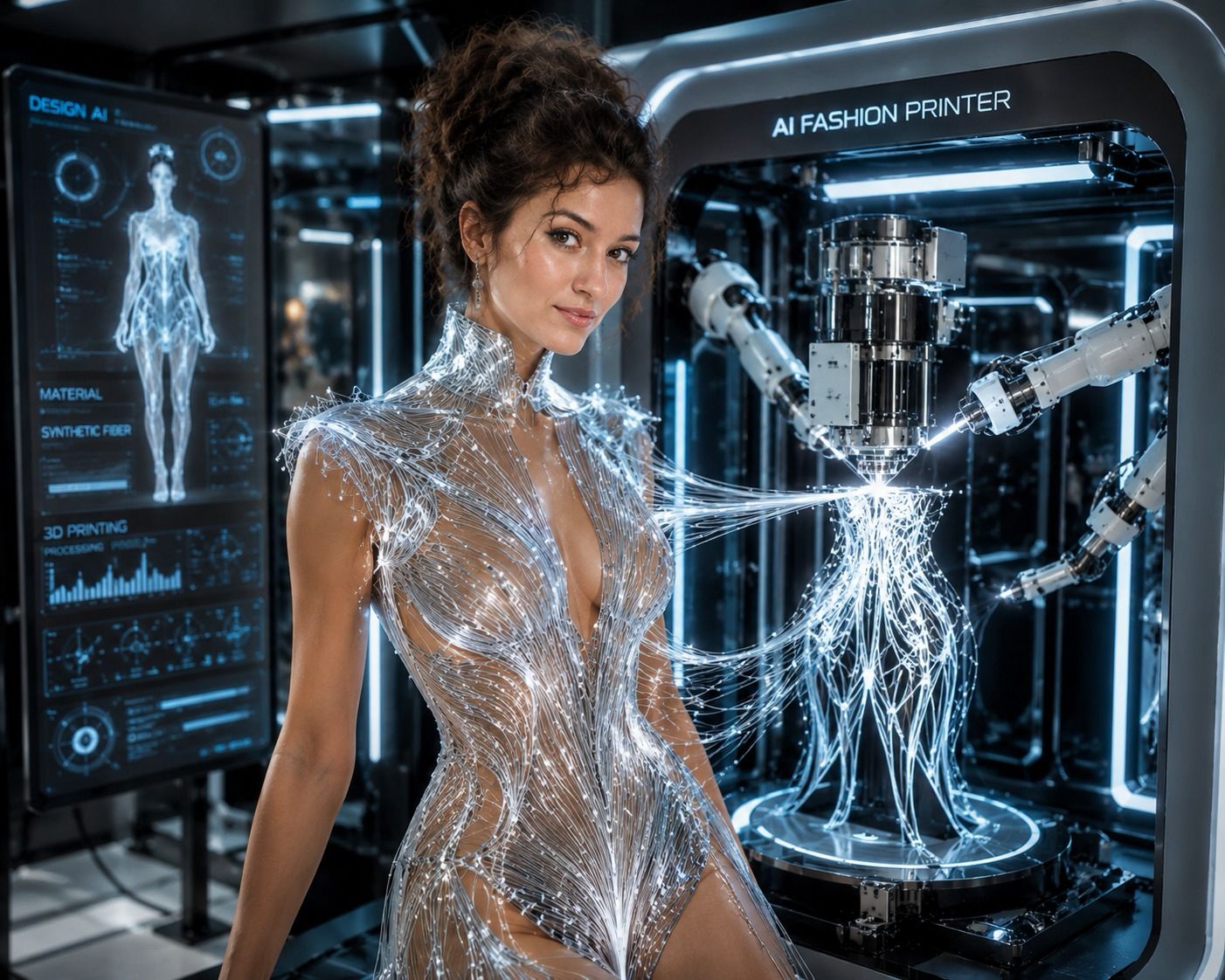
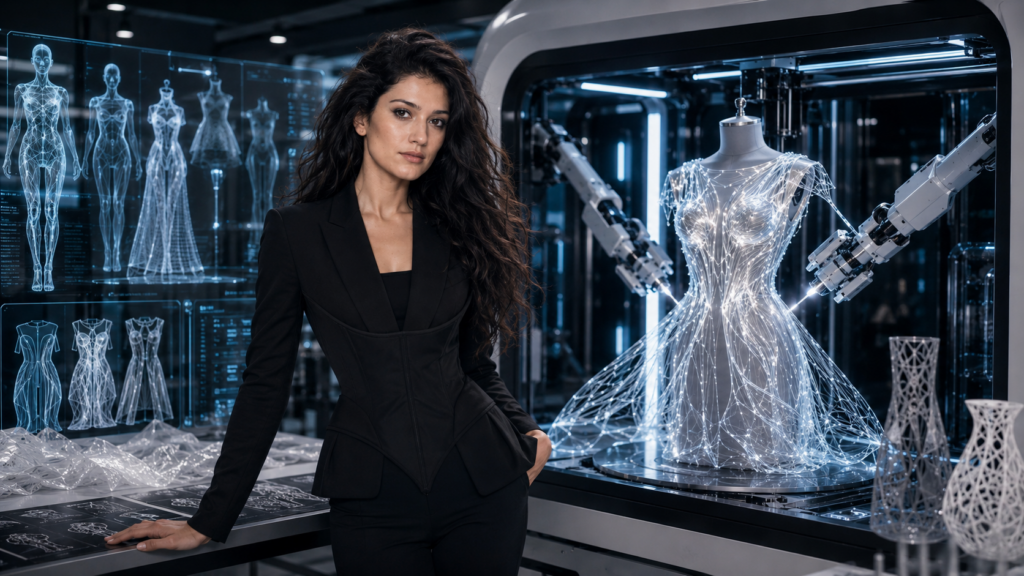
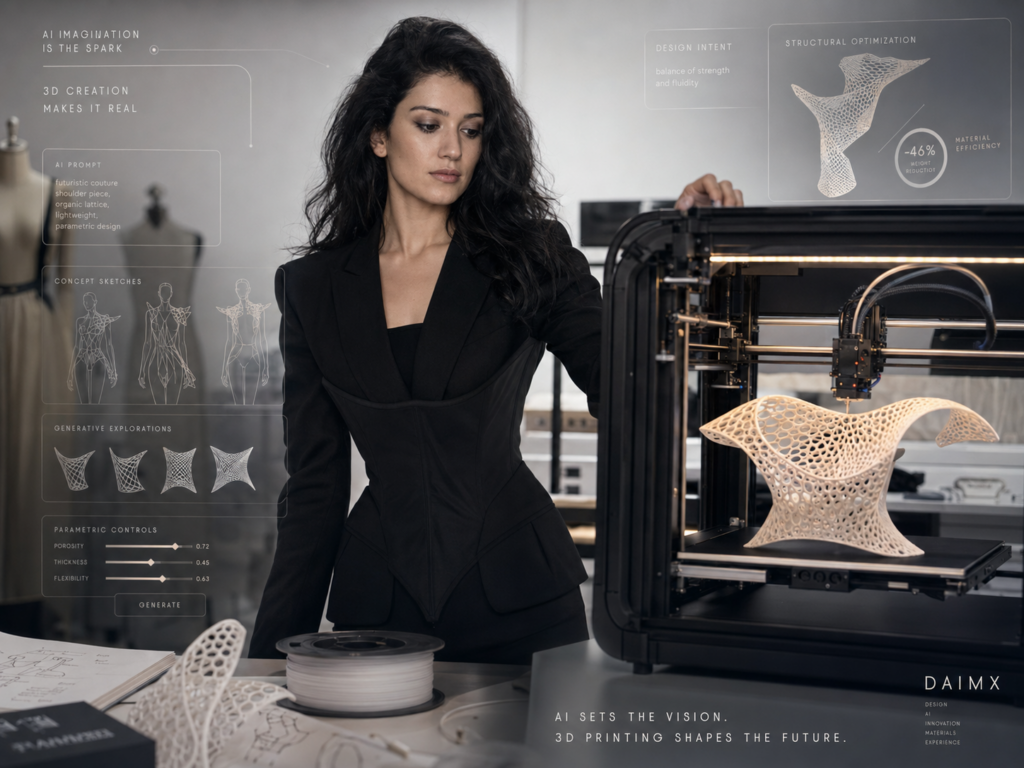
3D printing introduces something AI alone cannot provide: material possibility. It allows designers to move beyond the flat illusion of an image and into the spatial logic of an object, in fashion, that changes everything. 3D printing makes it possible to create: sculptural structures that would be nearly impossible to build by hand ultra-precise lattice systems and parametric surfaces exoskeletal forms that sit around the body rather than simply on it articulated components that move, flex, or respond to motion modular garments, accessories, and body architecture that combine engineering with aesthetics This is not about replacing craftsmanship, it is about expanding what craftsmanship can become. In the same way that couture once pushed embroidery, tailoring, draping, and hand construction to their limits, future couture may push computational design, digital fabrication, and intelligent materials into a new artistic language. 3D printing does not remove the designer from the process, It demands even more from the designer, because when form becomes more complex, intention becomes more important.
From Impossible Image to Buildable Form One of the biggest weaknesses of AI fashion today is that many generated garments are visually compelling but physically incoherent. A dress may look spectacular in a render, but: how does it support itself? how does it move? what happens at the shoulder, waist, or spine? where is the weight distributed? what material would actually hold that shape? These are not minor technical questions, they are the difference between fantasy and design. This is why 3D printing is so important. It forces the creator to think in volume, tension, structure, balance, repetition, articulation, and wearability.It transforms “impossible fashion” into a more serious creative investigation. What if an AI-generated shoulder silhouette became a 3D-printed body frame? What if a liquid-metal illusion became a modular shell of interlocking printed cells? What if lace evolved into bone-like architecture? What if a corset became an exoskeleton? Suddenly, the image is no longer the final product, It becomes the first draft of a future object, that is where true innovation begins.
Personalized Approach
AI Can Imagine. But It Cannot Replace Design Intelligence. AI is one of the most powerful creative accelerators the fashion industry has ever seen. It can help artists and designers: explore silhouettes faster test visual directions create speculative couture concepts build moodboards beyond conventional references imagine forms that traditional sketching might never reach Used well, AI can expand creative thinking, but AI is not a designer, a prompt can create an output, A designer creates a language, this distinction matters more than ever. In today’s digital landscape, fashion is increasingly crowded with visually impressive but conceptually empty content. There is no shortage of glossy fantasy garments, dramatic AI-generated “couture” moments, or digital characters dressed like they just escaped a chrome cathedral. And yet, many of these visuals stop at surface level. Without construction, without context, without material awareness, and without a clear point of view, AI risks becoming visual noise dressed as innovation, Technology can generate form, only vision creates fashion.
Superior Customer Service
The Real Designers Already Know This The most interesting part? The real innovators in fashion are not treating technology like a party trick, they are using it as a design language. Long before AI became everyone’s favorite shortcut, designers like Iris van Herpen were already proving that future fashion is not just about looking advanced it is about building what traditional methods alone can barely achieve. She is widely recognized as one of the true pioneers of 3D-printed couture, merging digital modeling, engineering, and hand-finishing into garments that feel somewhere between biology, architecture, and dream logic. Vogue has repeatedly highlighted her as a leading force in 3D-printed couture experimentation. When talking about 3D printing, fashion, and true material innovation, Julia Koerner is an essential name. She collaborated with Stratasyson collections where 3D-printed structures were directly combined with textiles, including flexible and multi-colored applications. Stratasys documents her Arid Collection and Sporophyte Collection as prime examples of wearable, experimental 3D fashion. Danit Peleg became known as one of the first designers to truly bring 3D-printed fashion to a broader audience. While Iris and Julia focus more on high-concept, couture, and architectural designs, Danit brought it closer to: Wearables Consumer-focused experimentation Digital distribution Home production as a concept She is important because she proved that: 3D fashion doesn’t just have to be gallery-fodder.
Then there is Balenciaga, where Demna pushed sculptural futurism into couture territory with 3D-printed structural elements and armor-like silhouettes that looked less like clothing and more like controlled impact. In Balenciaga’s world, technology is not decoration it becomes silhouette, tension, and attitude. Vogue’s Fall 2023 Couture review explicitly referenced a chrome-laminated 3D-printed armor look. Balmainhas also entered that territory through sculptural body architecture, including futuristic bustiers and engineered corsetry that blur the line between garment and object. In luxury fashion, this is often where 3D printing becomes most powerful: not in basic clothing, but in the anatomy of statement pieces. Vogue’s coverage of the Balmain x Beyoncé Renaissance Couture project specifically mentioned 3D-printed bustier structures. And then there is Coperni a house that understands something crucial about fashion right now: technology is not just a tool, it is a narrative. While Coperni is not purely a 3D-printed fashion house, it has become one of the clearest examples of tech-as-fashion-performance, from experimental fabrication moments to object-based innovation such as its 3D-printed CD-player bag. Fashionista highlighted that bag in the Spring 2024 collection review. In other words: The houses shaping the future are not just generating images, they are designing systems. The Shift From Spectacle to Substance For years, fashion has celebrated image-making, Now, the next generation of creators must move beyond image-making and into system-thinking, the question is no longer: Can AI make something look futuristic? Because yes. Obviously, It can, sometimes too easily, the real question is: Can this idea evolve into something meaningful, wearable, buildable, or culturally relevant? This is where the conversation becomes more interesting, because the future of fashion is not just about digital fantasy, it is about the bridge between imagination and fabrication and that bridge is becoming increasingly visible through 3D printing.
This is where things get practical, because not every “fashion-tech visionary” needs an industrial machine in the living room next to the coffee table.
The right 3D printer depends on what you want to create.
1. For beginners / concept development / wearable experiments
A strong beginner-to-serious option is something like a fast enclosed desktop printer such as the Creality K1 Max especially if you want a larger build volume for experimental fashion shapes.
A consumer example in this direction is the Anycubic Photon Mono 4 Ultra, which fits more for detailed prototype parts than for full wearable structures.
If someone truly wants to move toward real future fashion prototyping, SLS is where things become much more interesting.
Why?
Because SLS can create:
stronger nylon parts
interlocking geometries
no support structures the way FDM often needs
more professional wearable frameworks
complex lattices and articulated systems
A known entry-level professional path here is the Formlabs Fuse ecosystem, often used for nylon part production and functional prototyping. Formlabs positions the Fuse 1+ 30W for nylon SLS production workflows.
4. For true couture-tech / textile future / luxury experimentation
This is where industrial systems enter.
A major reference is Stratasys’J850 TechStyle, which is specifically marketed toward direct printing on textiles and fashion/luxury applications. That is the kind of machine that points toward the future of hybrid couture: textile + printed structure + material layering. Stratasys explicitly positions the J850 TechStyle for fashion and direct-to-textile workflows.
The Printer Fashion Actually Needs in the Future
Now this is where it gets exciting.
Because honestly? The ideal 3D printer for fashion does not fully exist yet at least not in the way visionary fashion really needs it.
The future fashion printer should be:
A Hybrid Couture Fabrication System
A machine that can:
print directly onto stretch textiles
combine soft and rigid materials in one pass
create graduated flexibility (soft at joints, rigid at structure points)
print breathable lattice zones
integrate transparent / translucent / matte / metallic material changes
allow body-scan-based custom fitting
generate modular repairable pieces
include AI-assisted structural correction (so the design is not just pretty, but actually wearable)
simulate movement before printing
predict pressure points on the body
support sustainable / recyclable material systems
That machine would not just print objects.
It would print:
wearable architecture
adaptive couture
body-responsive design
custom-fitted exoskeletal garments
future luxury pieces that sit between fashion, sculpture, and biomechanics
That is where fashion is heading, not toward “more random AI dresses, toward intelligent fabrication.
The New Creative Hierarchy: AI, 3D Printing, and Authorship
The next era of fashion will likely belong to creators who understand three distinct layers:
1. AI as ideation
AI can accelerate concept development, visual exploration, and speculative form generation.
2. 3D printing as translation
3D printing can transform radical visual ideas into material experiments, prototypes, and structural systems.
3. Human authorship as direction
The designer remains the essential force: defining taste, meaning, proportion, context, and purpose.
This hierarchy matters.
Because the future is not machine-made in the simplistic sense, It is machine-assisted, human-directed, and vision-led.
The strongest work will not come from people who use AI as a shortcut, It will come from those who use AI as a tool inside a larger creative ecosystem one that includes design thinking, fabrication logic, emotional intelligence, and cultural awareness.
Fashion’s Future Belongs to Visionaries, Not Just Generators
There is a growing difference between two kinds of digital creators.
The first creates endless output, the second builds a point of view.
The first is obsessed with quantity, the second is obsessed with language.
The first follows trends, The second shapes what comes next.
In fashion, this distinction is becoming impossible to ignore.
A future-facing creator does not ask, “How can I make the next viral AI image?”
A future-facing creator asks, “What aesthetic system am I building? What material future am I proposing? What form has not yet existed and why should it?”
This is where AI and 3D printing become powerful together.
Not as gimmicks, Not as spectacle, Not as shortcuts, But as tools for creators who are ready to think beyond the screen.
At DAIMX, AI is not the final result, It is the beginning of a new design language.
A way to explore silhouettes that feel impossible, A way to imagine visual worlds before they exist, A way to push beyond the familiar, A way to question what fashion can become when image, identity, and innovation intersect, But imagination alone is not enough.
The real future begins when vision becomes structure, When structure becomes form. And when form becomes something that can exist beyond the screen, This is why the conversation around AI in fashion must evolve.
Not toward more noise, Not toward faster imitation, Not toward empty spectacle dressed in chrome and confidence.
But toward authorship, Toward material experimentation, Toward intelligent fabrication, Toward a new era where technology serves design not the other way around.
The future of fashion is not just visual, It is conceptual, It is structural, It is emotional, And increasingly, it is engineered.
Final Thought
AI can generate endless images, But only vision turns an image into design, And only making turns design into fashion. The next era belongs to those who can do both.