

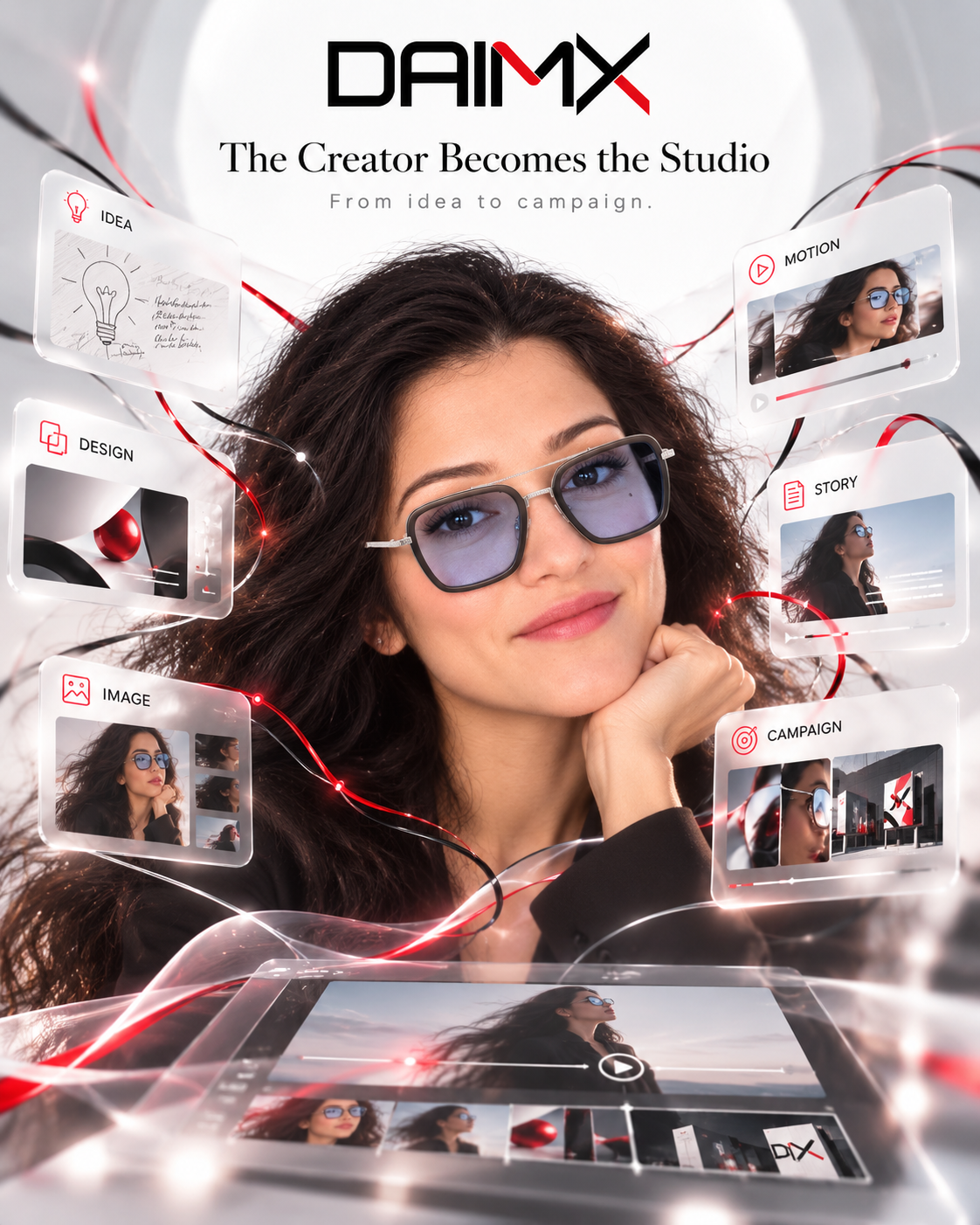
The Creator Becomes the Studio
How AI, design, motion and marketing are merging into one creative workflow
After finishing my studies, I realised something very quickly:
- I did not want to stop learning.
- If anything, finishing a course only made me more curious.
During my studies I learned how AI can support design, video, content creation and marketing. But once the assignments were finished, I started looking at what was happening outside the classroom.
I started reading articles from the Figma Blog about Figma Make, MCP and AI-assisted design-to-code workflows, including Laura Fehre’s “Workflow Lab: Deploying Designs Directly with Figma Make” and Riccardo Erra’s “Workflow Lab: Moving Between Design and Code with Agents.” I also followed Adobe’s Firefly updates, especially articles about agentic creative workflows and AI-assisted production, and watched practical tutorials such as TD Sunshine’s “Figma Make Tutorial & Best Practice Guide,” as well as Runway Academy’s Gen-4 courses on references, character consistency and generative video workflows.
Figma AI moved from being simply a design tool in my mind to something closer to an agentic design environment: a place where an idea can evolve into interface concepts, editable layouts, prototypes and even code-backed experiences. Figma now connects design systems, AI agents, prototypes and development workflows through tools such as Figma Make and its MCP server. Figma
Notion AI became useful in a completely different way: as an AI-enabled knowledge workspace for research, project structure, notes, planning and content development. Instead of treating research and production as separate activities, information can increasingly stay connected to the project itself. Notion
Then there were platforms such as Higgsfield, with its AI-native image and video environment, cinematic workflows, camera-motion tools, character consistency systems and specialised studios; and Luma AI, whose current Ray models focus on generative video and motion. Higgsfield
Somewhere in that process, I noticed something bigger.
I started following product and design publications, official platform blogs and specialist tutorials: Figma’s own design and AI articles, Adobe’s Firefly and Creative Cloud updates, Runway Academy, and independent creators who break down practical workflows rather than only showing final results.
And somewhere in that process, I noticed that the role of a creator is changing much faster than I expected.
Not because one tool suddenly does everything, but because more and more tools are starting to connect…
From learning tools to understanding workflows
During my studies, a lot of the focus was naturally on learning separate skills:
- How to create.
- How to edit.
- How to build a visual.
- How to use AI.
- How to think about marketing.
- How to tell a story.
- At first, I saw those things as separate disciplines.
- Now I see them more as parts of one creative system.
- A moodboard can become a campaign.
- A still image can become motion.
- A piece of music can become a visual identity.
- A prompt can become a prototype.
- A prototype can become a story.
And a story can become content for multiple platforms, that is where things became interesting for me.
The tools are changing
The development of creative software is no longer just about adding AI buttons to existing applications.
The applications themselves are changing.
Framer AI, for example, now combines an AI agent with responsive web design, editable layouts, CMS content, publishing and even custom code components. A prompt can become the beginning of a functioning website rather than simply a block of generated copy. Framer
Uizard focuses on AI-assisted UI/UX prototyping. Text can become editable multi-screen interfaces, while screenshots and hand-drawn wireframes can be transformed into digital mock-ups. uizard.io
Midjourney remains powerful for visual ideation, text-to-image generation, image prompting, style exploration and aesthetic direction. It is especially useful when the goal is not simply to produce one finished image, but to explore a visual world before committing to a direction. Midjourney
Adobe Firefly has expanded far beyond image generation. Its creative AI environment now covers images, video, audio, vectors, generative editing and moodboarding, while remaining connected to Adobe’s professional production ecosystem. Adobe
Canva AI and Magic Studio are moving Canva far beyond its original reputation as a template platform. AI-assisted design, image generation, video, text, brand tools, generative editing and editable layouts increasingly live inside the same Visual Suite. Canva
Recraft interests me particularly because it approaches AI from a graphic-design perspective. It combines raster generation with native vector generation, SVG output, mock-ups, editing and reusable styles. That makes it particularly relevant for brand systems, logos, icons and production assets where scalability matters. Recraft
And Leonardo AI combines generative imagery, image editing, motion and resolution enhancement in one creator-focused platform. Leonardo.ai
What surprised me was not simply what these tools could generate.
It was how much of the creative process they were beginning to touch.
At some point, switching between tools stops feeling like switching between unrelated applications.
It begins to feel like directing a creative pipeline.
A book changed the way I looked at it
Around the same time, I read Co-Intelligence by Ethan Mollick. Ethan Mollick — Co-Intelligence
What stayed with me was not the idea that AI should replace creative work.
Quite the opposite.
The interesting part is what happens when AI becomes something you work with:
- A collaborator.
- A sparring partner.
- A second pair of eyes.
A tool that can challenge an idea, offer an alternative, speed up exploration or help turn one concept into several directions, that also made me look differently at what I had learned during my studies, the technical knowledge was important.
But learning how to think with the tools may be even more important.
Prompt engineering is not just writing prompts
This is something I understand much better now than I did at the beginning, Prompt This is something I understand much better now than I did at the beginning.
The term prompt engineering can make the process sound as if everything depends on finding one perfect sentence.
Creative AI does not really work that way.
A serious workflow involves multimodal prompting, reference images, style references, composition, camera language, constraints, iteration, selection and evaluation.
It may involve prompt chaining, where the output of one stage becomes the input for another.
It may involve reference conditioning, where an image, layout or visual identity guides the next generation.
It may involve inpainting, where only a selected part of an image is regenerated, or outpainting, where the visual canvas is extended beyond its original boundaries.
And increasingly, it involves consistency control: keeping a character, product, colour system, environment or brand identity recognisable across multiple assets.
- You generate something.
- You compare it.
- You adjust it.
- You decide what works.
- You reject what does not.
- Then you move forward.
- That is not so different from traditional creative work.
- The difference is speed.
- And scale.
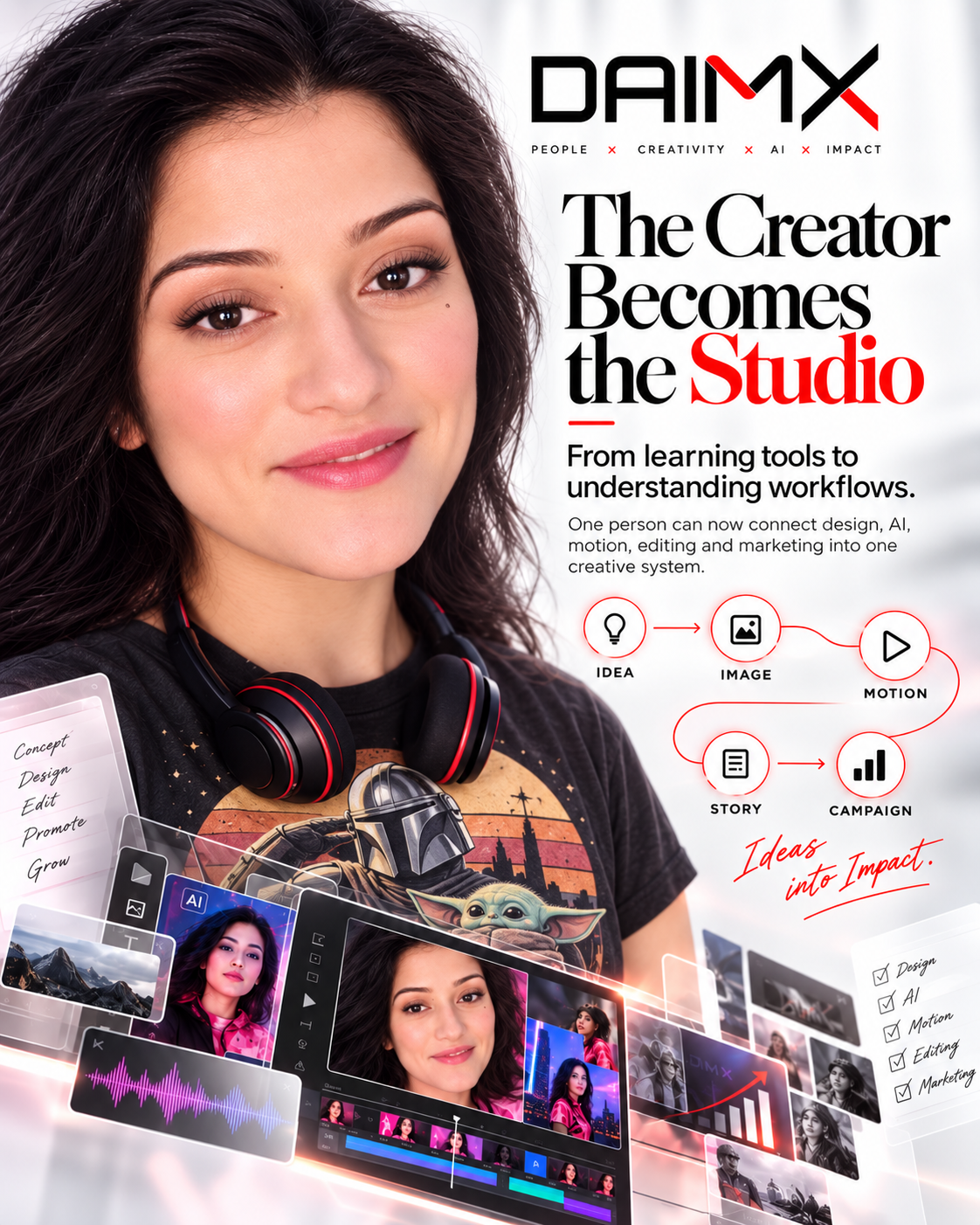
From image to motion
That is where platforms such as Runway and Higgsfield become especially interesting.
Runway’s current generative-video workflow includes text-to-video and image-to-video, with its Gen-4.5 generation offering detailed control over motion, sequencing and camera choreography. Runway
Higgsfield approaches the same space through an AI-native creative suite that brings together video models, cinematic tools, image generation, editing, character systems and specialised production environments. Higgsfield
And after generation comes editing.
Adobe Premiere remains a non-linear editing system — NLE — where timing, colour correction, audio mixing, effects, masks, titles and final narrative structure come together. Adobe
This is an important distinction.
AI generation is not the same thing as filmmaking.
Generation creates material.
Editing creates meaning.
The same is happening in marketing
Marketing used to feel like something that happened after the creative work, now it often begins at the same time, when I create something, I am already thinking about:
- What is the hook?
- Where will this be shown?
- Is it a Reel?
- A Story?
- A website hero?
- A campaign visual?
- A short video?
- A post?
- A teaser?
- Should it work with sound?
- Does it need text?
- How will it look on mobile?
That means content creation and marketing are no longer separate steps, they are becoming part of the design process itself.
Learning outside the classroom
Some of the most useful things I have learned recently did not come from a formal lesson.
They came from curiosity:
- A YouTube tutorial.
- A designer explaining a workflow.
- A TikTok showing a new editing technique.
- An article about a new AI feature.
- A creator comparing tools.
- A failed experiment.
- Trying something myself and realising why it did not work.
- That kind of learning is messy.
- But it is also very real.
The tools change too fast to wait for the next course, sometimes the only way to stay current is to keep watching, reading, testing and asking questions.
One person, many roles
This is where the idea behind this blog really started, a modern creator can increasingly move between roles that used to belong to different people:
- Concept development.
- Prompt engineering.
- Graphic design.
- Photography.
- Video editing.
- Motion.
- Sound.
- Copy.
- Marketing.
- Publishing.
That does not mean every creator suddenly becomes an expert in everything, and it does not mean specialists are no longer needed.
But it does mean that one person can understand and direct far more of the process than before. That changes the definition of a creative studio, sometimes the studio is no longer a building full of departments.
Sometimes the studio is one person connecting the right tools in the right order.
From tool user to creative orchestrator
For me, that is the most exciting part of what is happening now:
- Not that AI can generate an image.
- Not that AI can create video.
- Not that AI can write text.
- But that one creator can increasingly move from idea to execution without losing the thread in between.
- The real skill may not be knowing every platform.
- It may be knowing how to connect the right ones.
- When to use AI.
- When not to.
- When to generate.
- When to edit.
- When to stop.
- And when to trust your own judgement.
- That is also how I now look at DAIMX.
- Not as one discipline.
- Not only fashion.
- Not only video.
- Not only AI.
- But as a connected creative process.
- One idea can become an image.
- That image can become motion.
- The motion can become a story.
- And the story can become a campaign
DAIMX as a connected creative process
That is also how I now look at DAIMX.
- Not as one discipline.
- Not only fashion.
- Not only video.
- Not only design.
- And not only AI.
- I see it as a connected creative process.
- An idea can become a visual direction.
- That visual direction can become an image.
- The image can become motion.
- Motion can become a story.
- The story can become a campaign.
And the campaign can become part of a larger visual identity.
The technology matters.
But technology is not the final product.
The idea is.
AI simply gives creators more ways to develop it.
And perhaps that is where creative work is heading.
The future of creative work may not belong to the person who knows the most tools. It may belong to the person who knows how to connect them.
Diana Trinchinet
Related Posts
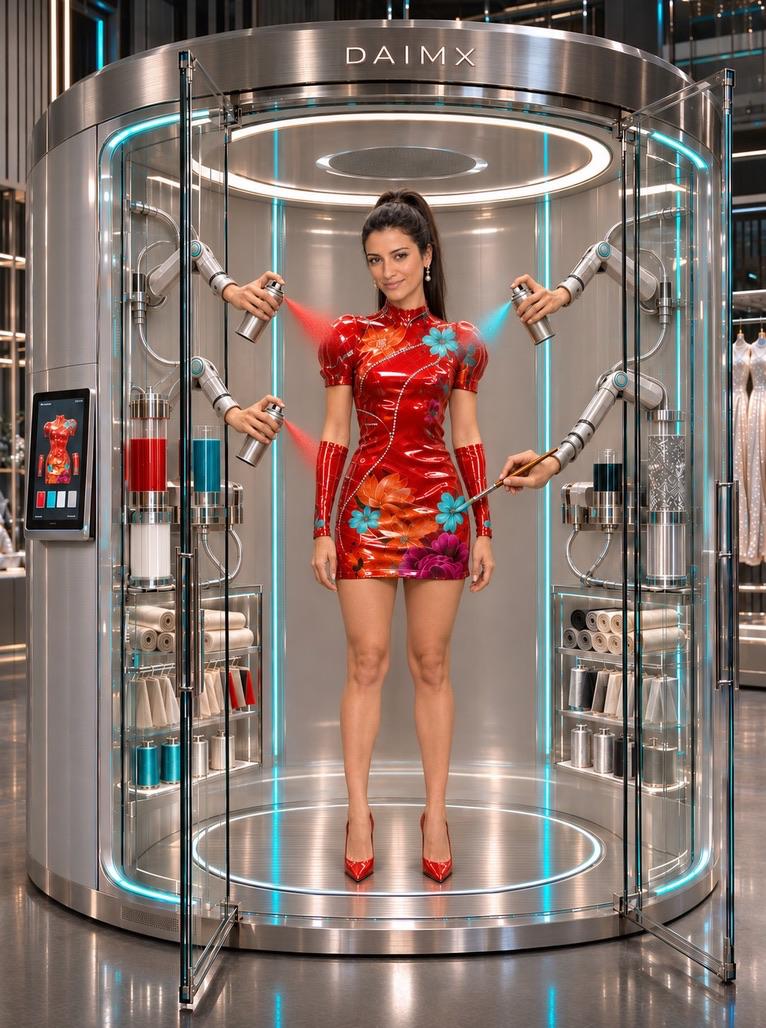 Beyond the Runway: When Imagination Becomes Something You Can Wear
 Dacă AI poate fi eliminat la editare, cine poate dovedi că a existat?