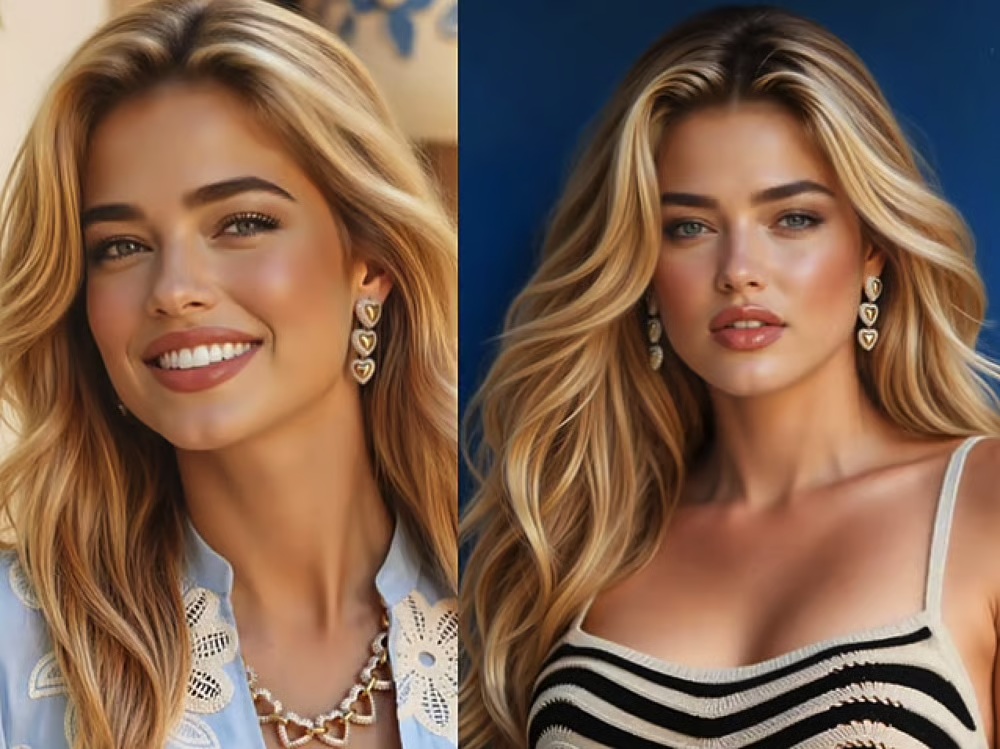
The first examination was largely about possibility.
Can AI generate models?
Can it modify real photographs?
Can it accelerate campaigns?
Can it lower production complexity while preserving the product?
The second examination asks a much less glamorous question:
Fine. Now who is responsible?
Suddenly the subject is no longer only creativity.
It is:
copyright,
privacy,
the EU AI Act,
deepfakes,
liability,
business secrets,
Shadow AI,
documentation,
and human oversight.
The WBS assignment explicitly asks students to identify those legal risks and then create both legal and organisational safeguards.
And that leads to a problem I find much more interesting than simply asking whether an AI label is present.
The Photoshop Problem
Imagine that I create an image completely with generative AI.
Then I open it in Photoshop.
I crop it.
Correct the colours.
Retouch the face manually.
Replace part of the background.
Paint over details.
Move into Illustrator and rebuild graphic elements.
Then I export it.
Compress it.
Perhaps combine it with other material.
And export it again for social media.
What exactly is that image now?
100% AI?
80% AI?
AI-assisted?
Human-edited AI?
Digital artwork?
And more importantly:
Who can reliably reconstruct that complete production history from the final JPEG alone?
That is where the legal discussion becomes far more complicated than placing a small AI Generated label underneath an image.
A disclosure obligation is one thing.
Technical detectability is another.
Detection Is Not Proof
AI detectors are tempting because they seem to promise certainty.
Upload.
Wait.
Result:
92% AI GENERATED
Case closed.
Except creative production does not work like that.
A real photograph can be heavily retouched.
An AI image can be heavily rebuilt by hand.
A human illustration can contain one generated element.
A real model can stand in an AI-generated environment.
A synthetic model can wear a product recreated from genuine product photography.
A video can combine generated frames, conventional editing, compositing, colour grading and manual graphics.
Where exactly does AI begin?
And where does it end?
The final pixels do not necessarily contain the answer.
When Fashion Can No Longer Tell You Who Is Real
The Guess campaign published in Vogue made that problem visible in fashion.
The advertisement featured a photorealistic woman who did not actually exist.
The model had been created using AI.
The advertisement did contain a disclosure that the visual had been produced with AI by Seraphinne Vallora, but criticism focused partly on how easy that information was to overlook.
That is an important distinction.
There is a difference between:
the information technically being present
and
the audience actually understanding what it is looking at.
Traditional fashion photography has always manipulated reality.
Skin is retouched.
Bodies are adjusted.
Backgrounds are replaced.
Colours are corrected.
But a fully synthetic model introduces a fundamentally different possibility:
there may never have been a photographed human being underneath the image at all.
That brings us directly back to:
AI Modified
versus
AI Generated.
With AI Modified, reality still provides an anchor.
With AI Generated, the anchor can disappear.
And What Happens After Photoshop?
Now take that completely synthetic model.
Retouch it manually.
Change the hair.
Alter the dress.
Rebuild part of the face.
Replace the environment.
Add typography in Illustrator.
Export again.
What exactly should an external detector find?
The image may still originate from AI, but the visible and technical characteristics of the original generation may have changed substantially.
That does not remove any legal obligation to be transparent.
It simply means that:
legal responsibility cannot depend entirely on whether an outside observer can detect the AI afterwards.
When Synthetic Identity Stops Being Entertainment
This becomes much more serious when synthetic identity is used to deceive rather than advertise.
In France, a woman transferred approximately €830,000 to scammers who convinced her that she was in a relationship with Brad Pitt.
The fraudsters sent fabricated selfies, falsified documents and videos using artificial intelligence.
At that point the issue is no longer:
Did this campaign label its AI model prominently enough?
It becomes:
identity fraud,
emotional manipulation,
financial crime,
and reputational harm.
AI does not need to fool everyone.
It only needs to fool the right person at the right moment.
The Tom Cruise and Brad Pitt Video
The recent AI-generated Tom Cruise and Brad Pitt example makes a different point.
Here, a highly convincing celebrity scene was created using ByteDance prompt-to-video technology rather than a traditional film shoot involving the two actors.
That matters because the viewer sees recognisable public figures performing something that never actually happened.
The question becomes:
How is the audience supposed to know that the event itself is synthetic?
And when such a video is subsequently edited, colour-graded, compressed, republished or combined with conventional post-production, the production history becomes even more difficult to infer from the final file.
The lesson is not that detection is impossible.
The lesson is that detection alone is an inadequate governance strategy.
So Is There an AI Police?
Not in the cinematic sense.
There is no European officer scanning every Instagram image and knocking on the door because someone used generative fill. 😄
But there is enforcement.
Under the EU AI Act, responsibilities are distributed among national market-surveillance authorities, the European AI Office for relevant systems, and other competent supervisory bodies.
The transparency obligations under Article 50 became applicable from 2 August 2026, and certain infringements can lead to significant financial penalties.
But regulators do not possess a magical forensic machine that can open a JPEG and announce:
Runway: Monday 11:34
Photoshop: Monday 12:07
Illustrator: Monday 12:42
original prompt: …
Real enforcement also depends on documentation, audits, internal records, source material, technical evidence and company processes.
And that leads to what I think may be the strongest idea in the WBS examination.