

Beyond the Runway: When Imagination Becomes Something You Can Wear
DAIMX concept film · AI-generated visualisation. Sound can be enabled using the player controls.
From Coperni’s spray-on dress to a robotic dressing chamber: fashion’s future needs imagination, material intelligence—and a credible way to bring them together.
On 22 June 2026, DAIMX published Couture-ul viitorului nu este doar generat, ci proiectat. The article explored the distance between an extraordinary AI-generated image and a garment that can actually exist. That distance contains some inconvenient questions. What holds the shoulder up? Where does the fabric stretch? How does someone sit down? And, somewhere between the spectacular silhouette and the dramatic lighting, did anybody remember that the wearer needs to breathe? These questions are where an image begins its development into clothing.
Coperni appeared in that earlier conversation as a house using technology as part of its creative language. Its subsequent closure adds a difficult business dimension. Its experiments still offer a starting point for imagining what could come next.
The moment the material became the show
On 30 September 2022, during Coperni’s Spring/Summer 2023 show at Paris Fashion Week, Bella Hadid stepped onto a platform at the Musée des Arts et Métiers in Paris. A team led by Dr Manel Torres, inventor of Fabrican’s spray-on textile technology, applied material directly onto her body. The white dress was then shaped and finished before she walked the runway. As British Vogue documented that evening, the audience witnessed the garment taking form. Its construction became part of the presentation.
This was spray-on textile formation. It was neither conventional 3D printing nor an AI-generated illusion. That distinction makes the achievement more interesting: a material process briefly became something the whole fashion world could watch.
When fashion stepped inside a story
On 1 October 2024, Coperni presented its Spring/Summer 2025 collection at Disneyland Paris, with Sleeping Beauty Castle as its backdrop. Disney’s involvement extended into the collection. Princesses, villains and familiar characters informed the designs. Kylie Jenner closed the show, while Disney documented the collaboration and the launch of Disney x Coperni: The Princess Collection in its official account of the event. The two presentations explored different possibilities. In 2022, the process of forming a textile became the spectacle. In 2024, clothing entered a world of shared stories and cultural memories.
Together, they raise a question that interests me: how could technology help someone participate in creating the world they imagine wearing?
What the spotlight cannot protect
On 4 November 2026, Vogue reported that Coperni had ceased operations following an unresolved dispute with its distributor and shareholder, Tomorrow. Founders Arnaud Vaillant and Sébastien Meyer cited unpaid sums. Earlier Vogue reporting on the company’s court protection described Tomorrow as its exclusive distributor and majority shareholder. The reported circumstances concern finance, ownership and control. They do not establish that technological experimentation caused the closure. Nor do the sources cited here establish Disney’s involvement in that dispute. For an independent studio, the broader lesson is worth examining.
The organisation designing a collection may depend on another organisation to distribute it and transfer revenue. If money is delayed, wages, suppliers and future development still need funding. Visibility does not remove that dependency. Who receives customer payments? Who controls the budget? Who owns the trademark? What happens to designs and unpaid balances when a partnership ends? These are questions for the actual agreements governing a business. Their answers influence whether a creative team gets to make its next collection. The freedom to experiment needs a structure capable of supporting it.
My vision: a room that makes your clothes
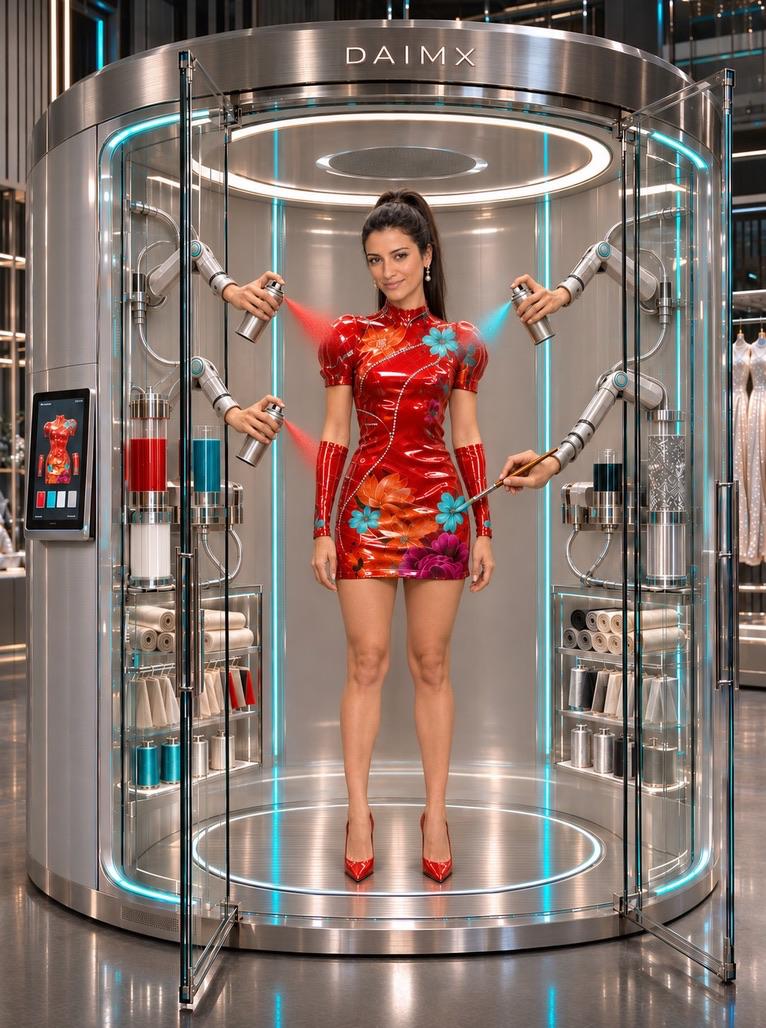
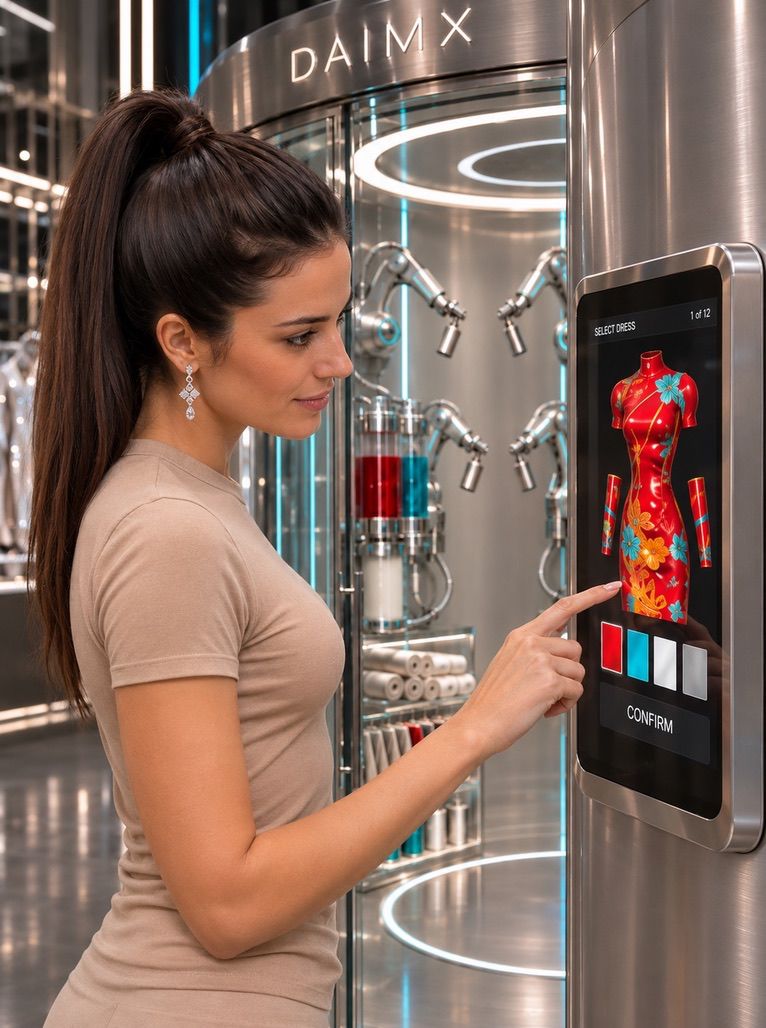
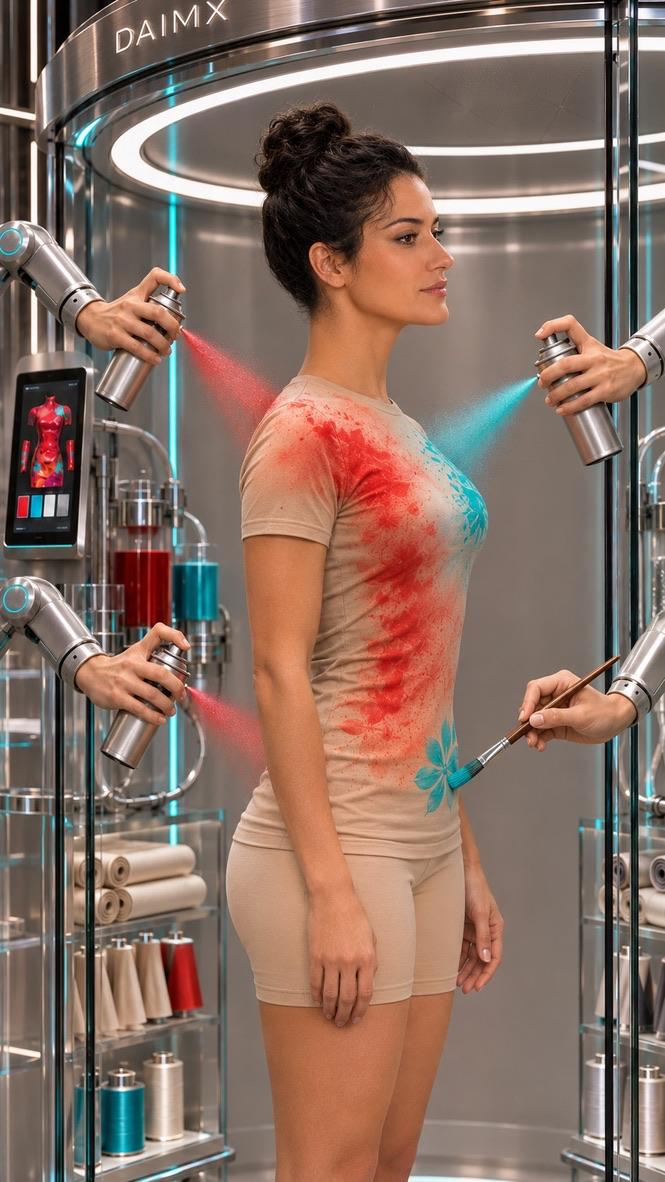
Now imagine a different kind of dressing room. You enter, choose a silhouette and adjust its details. A digital preview shows the intended fit. The system explains which materials and construction methods could realise it, alongside the price. Once an approved design is ready, robotic equipment helps manufacture the garment. I think of this as a robotic dressing chamber: a proposed combination of personalised design, body measurement, sprayable textiles and automated fabrication. It is not an existing DAIMX product.
It also has precedents. Fabrican already describes robotic spraying and programmable textile production, including a schematic for a spray-manufactured T-shirt. Popular Science’s 2022 coverage also discussed Torres’s earlier vision of customised clothing produced in a booth. The opportunity is to explore how these capabilities could become a coherent service: understandable choices, validated designs, reliable production and transparent payment.
The DAIMX images and film accompanying this article are AI-generated concept visualisations. They do not show an operational machine, a proven material formulation or a validated safety process.
What would actually come out of the nozzle?
The material is central to the idea. Fabrican describes a liquid suspension that forms a nonwoven textile as fibres bond together. A nonwoven structure does not rely on the interlaced threads of woven cloth or the loops of knitting. The company lists fibres including cotton, wool, nylon and cellulose across its platform. These possibilities are not a confirmed ingredient list for Bella Hadid’s dress or a future chamber formulation. For our concept, material development would need to answer three questions:
- Structure: which fibres and binding system provide the required strength and flexibility?
- Application: how does the formulation flow, deposit and dry?
- Wear: what properties remain once the material is against a moving body?
A soft appearance does not prove breathability. Stretch does not prove recovery after repeated movement. A garment that survives a runway walk has not necessarily demonstrated everyday durability. The material library would therefore need measured results: thickness, weight, tear strength, stretch recovery, air permeability, abrasion resistance and cleaning performance. Those measurements would help determine which designs the system could honestly offer.
One garment may need several construction methods
Imagine a dress with a sculptural shoulder, a stable waist and flexible hips. Each area asks something different of the material. A practical solution might combine a conventional textile base, a sprayed surface and a separately produced supporting component. As explored in our earlier article, 3D printing could contribute to those separate elements. Systems such as the Stratasys J850 TechStyle also demonstrate another route: printing polymer features directly onto textiles. These processes should remain distinct in the explanation. Their potential lies in how designers might combine them.
A dramatic shape may become feasible through a hybrid construction. Another may need to change substantially before it becomes comfortable or manufacturable. That negotiation is part of design.
From body scan to manufacturing instructions
An AI image does not contain a dependable construction plan. The proposed workflow would begin with body measurements and a three-dimensional model, collected with the wearer’s consent. The garment model must then add ease: the space needed for movement and the intended fit. Copying the body’s surface alone would not produce comfortable clothing. Next come openings, edges, fastenings, thickness zones and any separate components.
A production planner would translate the approved construction into tool paths. For spraying, experiments would need to establish how nozzle distance, angle, flow rate, movement speed and overlapping passes affect the finished material. Software could help simulate movement and identify potential problems. Physical prototypes would still be necessary to test those predictions. The system would need a reliable chain from measured body to approved garment to validated manufacturing instructions. That chain is the real engineering challenge.
Humanoid arms, sensitive fingers—and the right tool
A full humanoid might look impressive inside the chamber. Purpose-built arms could offer a more practical starting point. For comparison, Franka Research 3 provides seven degrees of freedom and torque sensing at each joint. These are useful research capabilities for positioning and force-sensitive control. They do not establish suitability for spraying garments onto people. In our proposed layout, two arms might handle different application angles. Another tool could assist with components or finishing. Where contact requires dexterity, Shadow Robot’s dexterous hands provide a relevant reference. Its tactile sensors can supply information about contact forces.
But sensing touch and understanding a delicate garment are different challenges. A nozzle needs controlled positioning. A hand manipulating an edge needs information about grip, tension and slippage. The control system must interpret that information correctly. For initial development, I would separate spraying, removal and finishing. Cutting or trimming could take place on a dress form, away from the wearer. Human supervision or remote operation could precede autonomous finishing. The first prototype should prove a limited task reliably.
How would someone choose a creation?
I imagine three entry points. The collection: select a tested garment with approved colours, lengths and finishes. The adaptation: start with a validated design and modify it within established construction limits. The original concept: submit a sketch, description or visual reference for technical assessment and development. The interface could show a rotating preview alongside material options, intended fit, construction details and care requirements. It should explain why certain changes are available and others require development.
A longer hem might increase material use. A sculptural shoulder might introduce a separate component. Greater transparency might affect coverage and where a base layer is needed. The price would update with those choices. Most importantly, the interface would distinguish a visual proposal from a tested garment.
What if your imagination is stronger than your technical skills?
Once the concept and its technical foundations are understood, another possibility emerges. Imagine someone who has tried to become a fashion designer and repeatedly struggled. They can picture extraordinary garments but cannot develop a workable pattern. Sewing frustrates them. Their execution never quite catches up with their imagination. Does that make their ideas worthless? I would ask what expertise could help those ideas develop. A system supported by garment specialists could suggest a different material, a lighter structure or a practical fastening. It could explain why one version fails and another deserves a prototype.
For an emerging creator, that could provide access to skills they have not yet developed. For an accomplished designer, it could offer another instrument for experimentation.
Creative vision deserves room to continue
My admiration extends to designers whose work has outlasted difficult chapters in the businesses associated with them. I think of Wolfgang Joop’s creative vision at Wunderkind, Gabriele Strehle’s contribution to Strenesse, and Alexandra Fischer-Roehler and Johanna Kühl’s work at Kaviar Gauche. Their stories concern established creative talent facing business pressures—a different challenge from learning how to construct a garment.
Wunderkind entered insolvency proceedings in 2019, after Joop had left in 2017. Strenesse filed for insolvency in April 2014, following Gabriele Strehle’s departure in 2012. In 2023, Kaviar Gauche’s operating company filed for insolvency, while the separate company holding the trademark rights was unaffected. These distinctions matter. Financial difficulty does not erase the creative contribution of a designer, and an operating company’s insolvency does not necessarily end a brand.
What I admire is the ability to establish a recognisable design language: a point of view that gives clothing identity beyond a single collection. I would love to see what designers with that depth of vision might explore through a technically mature version of this concept. Which forms would they investigate? Where would they combine sprayed textiles with tailoring? Which limitations would they challenge—and which traditional techniques would they insist on preserving? This is an imaginative invitation, not a suggestion that these designers endorse the project or need it to realise their work.
Nor would a robotic chamber automatically solve the financial pressures their businesses encountered. Its costs, reliability and commercial value would need to be demonstrated. But a useful tool could create additional ways to prototype, personalise or produce selected designs. That possibility deserves investigation.
More access, with honest promises
The opportunity reaches across different levels of experience: helping a beginner develop an idea while giving an established designer another way to test a demanding construction. Human judgement remains central. Someone must decide whether the result expresses the intended vision, feels right on the body and meets the promised standard. There also remains a responsibility to communicate honestly. Posting an elaborate AI garment does not demonstrate the ability to manufacture it. A concept, a prototype and a production-ready design represent different commitments.
The customer should always know which one they are buying.
For me, the ambition is to give imagination a better-supported route into the physical world—and to respect the expertise that makes that journey possible.
How would payment work?
For a tested collection, I would propose a fixed quotation after the customer selects permitted options. For original concepts, payment would follow development stages:
- Assessment: establish feasibility and the proposed construction route.
- Development: produce the technical model and agreed prototypes.
- Production: manufacture and finish the approved garment.
The customer could decide whether to continue at each agreed milestone. Payment itself could use an ordinary online checkout for catalogue orders, or an accepted quotation and deposit for custom work. The price would need to cover design rights, technical preparation, materials, machine time, finishing, quality control and operating margin. A designer contributing an approved catalogue creation could receive a negotiated fee or royalty per sale. Agreements would define attribution, permitted modifications and payment reporting. Buying a garment would not automatically transfer ownership of its underlying design.
These are proposed commercial arrangements. Credible retail prices would require measured costs, including rejected pieces, maintenance and staff time.
Before stepping inside: what would we breathe?
This concept needs a serious health discussion. A runway demonstration cannot establish the safety of repeated application inside an enclosed chamber. The assessment would need to identify airborne droplets or particles, any vapours, skin and eye exposure, drying conditions and formulation-specific fire risks. Fabrican describes cosmetic-grade components for direct-to-skin applications. That manufacturer statement does not establish inhalation safety for every formulation or operating environment. HSE’s guidance on solvents explains how spraying can increase airborne exposure and why enclosed spaces require particular attention. It also distinguishes particle filtration from protection against vapours.
This is general occupational guidance, not evidence that a particular Fabrican product contains the hazardous substances discussed there. For the proposed chamber, specialists would need the exact formulation’s safety documentation and independent exposure measurements. A transparent helmet alone would prove very little. Any breathing-air hood would need an assessed protective function, alongside effective extraction and a validated operating process. A general particle sensor would not identify every relevant vapour. Force-sensitive robots would not resolve chemical exposure. Cleaning and maintenance would require assessment too.
The sensible development route begins with samples and dress forms. Human application becomes a later question, supported by evidence.
Who has written about this?
The technology has attracted both fashion coverage and scientific reporting. British Vogue documented the Coperni presentation on 30 September 2022. Fashionista covered the same show and the role of Fabrican. Popular Science examined the material-science background on 4 October 2022. Vogue Business explored sustainability and practical questions on 20 October 2022. Nature Biotechnology published Lisa Melton’s news article, The instant spray-on dress, on 14 June 2023. It provides scientific context, rather than a clinical safety evaluation of the proposed chamber.
Together, these publications show an established field of experimentation. They do not demonstrate that a complete consumer dressing system has been solved.
The DAIMX perspective
Coperni’s experiments showed how material innovation and storytelling can capture attention. Its closure reminds us that creative work also depends on business relationships and financial continuity. The robotic dressing chamber brings those questions into one proposed experience. Who designs the garment? What makes it wearable? Who gets paid? What has been tested? What remains uncertain? At DAIMX, these questions belong inside the creative process. I am interested in the person who can imagine something extraordinary and needs help finding its physical form. I am equally interested in the specialists whose knowledge makes that translation possible.
A future worth building would give both a meaningful role.
Imagination opens the door. Knowledge helps us walk through it wearing something real.
Diana Trinchinet | DAIMX
Related Posts
 The Creator Becomes the Studio
 Dacă AI poate fi eliminat la editare, cine poate dovedi că a existat?